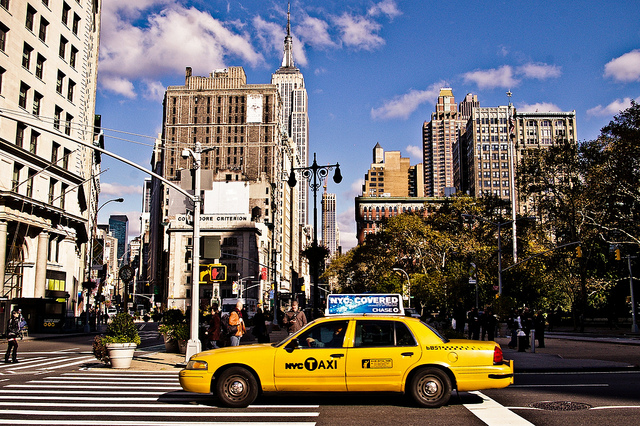
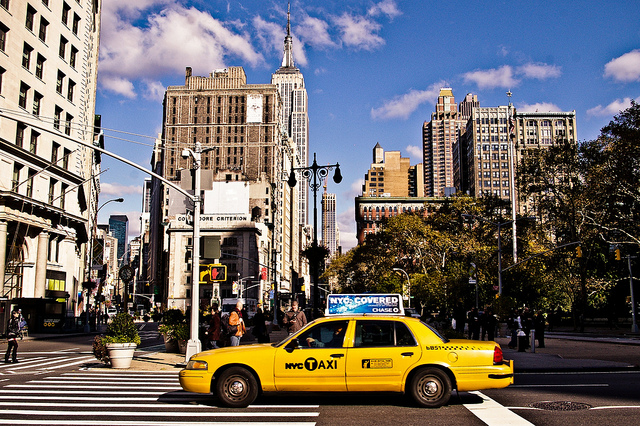
 New York City’s Taxi & Limousine Commission says you can’t use Uber to get one of these. (Photo by Olivier Perrin)
Add New York City to the list of places where Uber is running into trouble. The company, known best for its luxury-sedan-hiring mobile application, is shutting down another of its operations offered by its New York branch.
Last month, Uber introduced a new app that, instead of finding black-car services, offered users the ability to hail one of the city’s standard yellow cabs at the push of a button. The app, called Uber Taxi, was available in 168 of New York’s fleet of 13,000 taxis. Like Uber’s upscale sedan service, customers using the Taxi app also submitted their payments electronically, though they were charged according to standard cab rates instead of a proprietary fare schedule like the sedan app uses.
But today, Uber announced that it is suspending its taxi-hailing service in New York after a bit of head-butting with the city’s Taxi & Limousine Commission.
The taxi product, which rolled out just after Labor Day, quickly ran into the TLC, which currently prohibits taxis from taking pre-arranged rides—such as those requested over a mobile phone—and bans cabbies from using electronic devices while operating their vehicles. Uber supplied taxi drivers who signed up for the service with smartphones loaded with the company’s technology.
Now, Uber is asking its taxi drivers to return those devices, but is also trying to recruit them to join the sedan side of the business. The Verge reports that cabbies are being offered as much as $1,000 to sign up with its black-car roster. But Uber is also in for a bit of a financial hit, according to The Verge. The company is “about to take a very expensive bath,” a livery industry insider told the technology news website.
Travis Kalanick, Uber’s chief executive, wrote on his company’s blog that the TLC “put up obstacles and roadblocks in order to squash the effort around e-hail.” It’s hardly the first time Kalanick has bickered with a livery regulator; his 10-month squabble with the D.C. Taxicab Commission—and sometimes the D.C. Council—is the stuff of national attention.
“We’ll bite our tongues and keep our frustration here to ourselves,” Kalanick wrote.
Pre-arranged taxi rides are illegal in New York right now, but they won’t be for much longer. But it won’t be until next February at the earliest that the TLC will consider opening New York’s taxi fleet to taking customers who flag down rides by punching up a mobile app rather than, say, flailing their arms on a busy corner of Lexington Avenue.
“We are committed to making it as easy as possible to get a safe, legal ride in a New York City taxi, and are excited to see how emerging technology can improve that process,” TLC Commissioner David Yassky said in a statement released by his agency.
For now, though, Uber’s business in New York is limited to its upscale sedan service and UberX, a similar offering that employes less luxurious vehicles to provide rides at lower fares. The taxi application is still in operation in Boston and Toronto, cities that Kalanick calls “more innovation-friendly.”
In an email to DCist, Kalanick hinted that D.C. could be a future market for Uber’s taxicab operation. While the company and regulators here are frosty when it comes to sedans, the D.C. Taxicab Commission is welcoming toward mobile applications that call cabs with a few thumb swipes. Last week, myTaxi became the latest smartphone app to avail itself to D.C. taxi customers. Ron Linton, the commission’s chairman, told DCist that private dispatch services that use the existing taxi fleet and charge the standard fares are perfectly legal.
Could Uber join companies like myTaxi, Taxi Magic and Hailo in the D.C. taxicab market? “It’s definitely on our minds,” Kalanick said.