Rachel Kurzius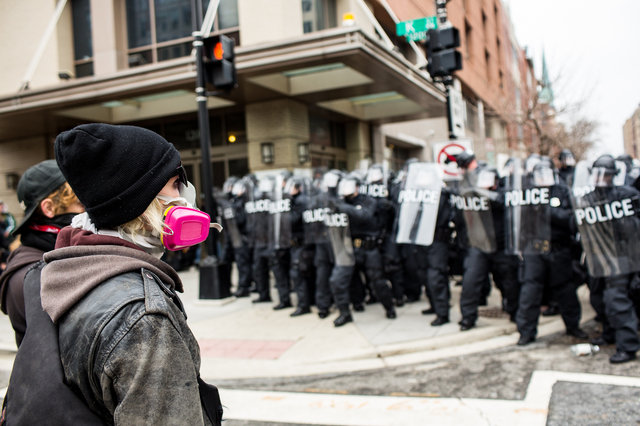
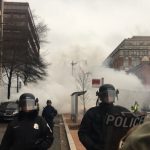
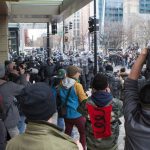
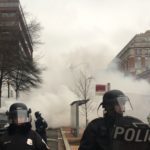
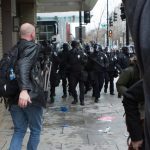
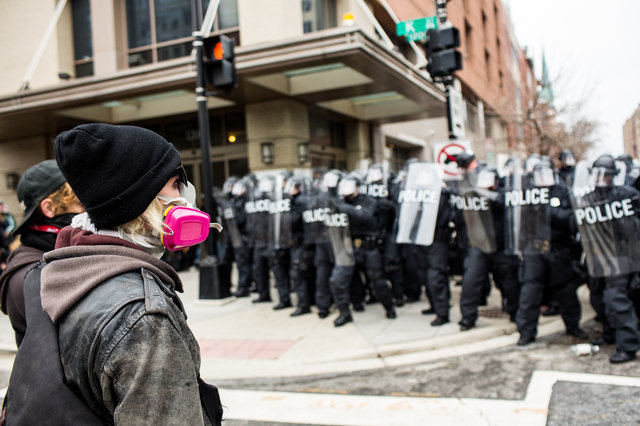 Police and protesters scuffle on Inauguration Day in D.C. (Photo by Scott Heins)
A group of local activists that formed in the wake of Inauguration Day protest arrests say they’ve raised tens of thousands of dollars for those facing felony riot charges, and are renewing their calls for an independent investigation into police conduct this week.
“We are here basically to fight police and state repression by providing support through housing, travel reimbursements, and hospitality to folks who were arrested and are now being maliciously prosecuted,” says Sam Menefee-Libey, a member of the newly formed Dead City Legal Posse.
On Inauguration Day, a total of 230 people were arrested by D.C. Police during a series of protests, and ultimately 214 of them were charged with felony rioting. While some of them are local, many others came to D.C. from other parts of the country.
Police and demonstrators scuffled that day in downtown D.C. amid window smashing and fires near Franklin Square. A recent court filing from prosecutors says the “violent riot” caused more than $100,000 in damages to buildings, property, and vehicles, and minor injuries to six officers.
Interim Police Chief Peter Newsham, who is awaiting confirmation, and Mayor Muriel Bowser have stood by the police’s actions that day, even after the Office of Police Complaints says it observed the indiscriminate use of nonlethal weapons like pepper spray without adequate warning, and the arrests of people who clearly did not commit crimes. The report formally asked for an independent counsel to investigate D.C. Police conduct.
“The Metropolitan Police Department stands by its assertion that our officers acted responsibly and professionally during Inauguration Day,” MPD spokesperson Rachel Reid said in an emailed statement after the report’s release. “In response to the riots, the men and women of MPD made reasonable decisions during extremely volatile circumstances.”
Dead City Legal Posse disagrees. The group is organizing a call-in campaign this week to Bowser and members of the D.C. Council, asking them “to pressure the U.S. attorney to drop the charges, and open a formal investigation with public hearings into the police brutality” on Inauguration Day, says Menefee-Libey.
Neither MPD nor the mayor’s office has committed to an independent investigation. Questions of Newsham’s handling of the protests have been part of the public hearings for his nomination as permanent chief. At those hearings, Judiciary and Public Safety Committee Chair Charles Allen spoke in favor of an independent investigation.
The campaign coincides with a week of solidarity from anarchist and antifascist groups to support arrestees at Inauguration protests, Standing Rock, and demonstrations against alt-right figures like Milo Yiannopolous. “How effectively we support arrestees will determine how effectively we can continue resisting,” says the call to action.
The phone calls are slated to come before the council’s MPD oversight hearing on April 12.
Local legal observers have characterized the mass felony charges, which carry a maximum sentence of 10 years and a $25,000 fine, a change from previous policy in the District.
Defense lawyers argue that many of the people arrested and charged were not responsible for the property damage. Already, the U.S. Attorney’s Office of D.C. has dismissed charges against journalists who were covering the protests.
One class action suit filed the day after Inauguration alleges police surrounded a group to prevent them from leaving (a tactic known as “kettling”) without first warning them. Then, the suit says, police “indiscriminately and repeatedly” used chemical irritants, batons, and flash-bang grenades against the people inside the kettle.
The American Civil Liberties Union of D.C. voiced concern “that law enforcement may have violated demonstrators’ rights” due to the corralling, pepper spray, and long processing times for arrests.
Menefee-Libey says he spent Inauguration Day volunteering as a street medic. “I treated dozens of people for pepper spray, blunt force trauma, rubber bullets, and more,” he says. “These were people who were not engaged in any antagonistic activity.”
But Dead City Legal Posse’s concerns stretch beyond what happened that day. They’re also troubled by news that prosecutors are mining data from cell phones confiscated by police.
They’ve raised tens of thousands of dollars for those facing charges, Menefee-Libey says, though because “this case is likely to stretch on for a long time, it’s unclear whether this is going to be sufficient.”
Updated with Charles Allen’s stance on the independent investigations.