Natalie Delgadillo
 Rachel Kurzius
 Rachel Sadon
 Martin Austermuhle
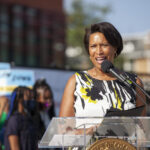
Muriel Bowser is poised to become the first D.C. mayor to win a second term since 2002. She is facing no notable competition in the general election, and she’s raised $2.5 million for her reelection campaign—significantly more than her opponents. As District residents most likely head into what will be at least four more years with the mayor, who was first elected in 2014 after serving as Ward 4 councilmember, it’s worth pausing to remember what happened during the first term. To that end, the team at DCist has compiled an alphabetized glossary of some major issues that defined Bowser’s first go-round.
AFFORDABLE HOUSING: The question of how to maintain affordable housing in a city where the cost of living is rising dramatically was one of the most urgent problems facing the mayor as she came into office. Bowser has made affordable housing a centerpiece of her agenda, which she often summarizes as providing “pathways to the middle class.” Her efforts have included putting $100 million each year in the District’s Housing Production Trust Fund, which was chronically underfunded in its earlier years. As a result, the city government has helped fund dozens of affordable housing projects. In the latest fiscal year, the city allocated $167.6 million to build affordable housing—the most ever allotted to the fund. However, critics have said the HPTF remains underfunded, given the serious dearth of affordable housing in the city. The D.C. Auditor has also criticized the way the fund is run, saying it suffers from “unreliable” reporting and that it doesn’t fully serve the most vulnerable Washingtonians. The auditor acknowledged, however, that the Bowser administration has made historic investments into the fund. Housing affordability and inequality (particularly along racial lines) remain profound problems for the District.
CRIME: During the first full year of Bowser’s term, violent crime in the District was up in many neighborhoods west of the Anacostia while remaining the same or lower east of the river, as compared to the previous year. In 2016 and 2017, violent crimes steadily dropped. But the city’s positive pattern has been disrupted in 2018, with a spike in homicides year-over-year. In May, the mayor deployed additional safety resources to areas most affected by these spikes, but by late September, the homicide total for the year had already surpassed 2017’s year-end total. At the end of last year, as directed by the NEAR Act passed by the council, Bowser opened the D.C. Office of Neighborhood Safety and Engagement, which does direct community outreach with people considered to be high risk for participating in or being victimized by violent crime. At the end of her first year in office, she also signed an expansive body-worn camera bill, which allows the subjects of a body-worn camera video to access the footage, and authorizes the mayor to disclose any footage she deems to be in the public interest. While she began her term, she kept Cathy Lanier as D.C. Police Chief, but after Lanier’s resignation in 2016, Bowser nominated longtime Metropolitan Police Department assistant chief Peter Newsham to be the new top cop.
DEDICATED FUNDING FOR METRO: Unlike just about every other subway system in the world, D.C.’s Metro never had a dedicated stream of funding—until 2018, that is. Faced with a four-decade-old system in steep decline and a general manager insisting that more money was needed to operate it, regional leaders, including Bowser, agreed to give the transit system $500 million a year for use on capital projects. The District’s portion is $178.5 million a year, paid for in part by a small increase in the sales tax and a tax on ridehailing services like Uber and Lyft.
DGS CONTRACTING SCANDAL: There’s a whole long story behind the scandals at D.C.’s Department of General Services, but the gist of it is that in 2016, the department head stepped down rather than fire two employees at the Bowser administration’s behest. One of them went on to sue the city, alleging that he was fired for not awarding a contract to a Bowser donor. Ward 3 Councilmember Mary Cheh, who oversees the D.C. Council committee with oversight of DGS, opened an investigation. Her report found that the Bowser administration granted a “most-favored” status of sorts to Fort Myer, a big and well-connected construction company.
ENVIRONMENT: After the Trump administration announced that the United States would withdraw from the Paris Accord, Bowser announced that D.C. would continue to work towards the historic global climate agreement’s goals to mitigate rising temperatures and greenhouse gas emissions. During her tenure, the city released a plan of 77 different actions to adapt to a changing climate, including increasing the durability of transportation systems and energy systems.Also under Bowser, the District became the first city on the planet to receive what is now the highest award conferred by the U.S. Green Building Council: the LEED for Cities Platinum leadership certification. (LEED stands for Leadership in Energy and Environmental Design, and it’s a way to get buildings certified as “green.”)
FIGHT FOR 15: In early 2016, Bowser announced she’d support the Council raising the city’s minimum wage to $15 by 2020. There was also a ballot initiative scheduled for that year which was extremely likely to have passed (and would have also raised the wage for tipped workers). Within two months and with little debate, the Council agreed, giving low-wage workers their first pay bump since 2013.
FIRE AND EMS: In earlier administrations, D.C. Fire and Emergency Services was plagued by a multitude of serious failures and scandals, including ambulances catching fire, inaccurate information from 911 dispatchers, and long wait times for medical help. In one 2014 case, an elderly man died after collapsing directly in front of a fire station and being refused help. When Bowser came into office, she put forth a plan to partially privatize the city’s ambulance services to help the fire department deal with a large spike in the volume of calls. Things weren’t completely smooth sailing from there, but a year into the privatization plan, response times from emergency services had improved significantly. The city government has also instituted measures to try to reduce the number of ambulance responses to non-emergency calls, including installing nurses in the 911 call center to determine which callers are actually in need of emergency response. That program has so far yielded tentatively positive results.
FRESH PAC: In her first year in office, Bowser’s supporters created a political action committee they said they would use to support her agenda and candidates that aligned with it in the city and nationwide. But FreshPAC was widely seen as a slush fund for corporations to give large amounts of money, and the mayor disbanded it.
HOMELESS SHELTERS: During her first campaign, Mayor Muriel Bowser pledged to close the dilapidated family shelter at D.C. General, where 8-year-old Relisha Rudd disappeared in 2014, and replace it with smaller shelters in each of the city’s eight wards. She kept her promise: the doors of D.C. General were chained shut on October 30 of this year. The road to that point was far from smooth, however. Councilmembers expressed concerns with the fact that a majority of the shelter sites would be leased from private landowners, some of whom were close to Bowser. The D.C. Council changed the sites to city-owned land instead. More recently, there have been concerns over the overuse of rapid rehousing and demolition taking place on the campus before the shelter was fully emptied. Still, Bowser fulfilled one of the key promises of her campaign in closing the shelter down for good, an accomplishment that eluded her predecessor.
HOMELESSNESS: There have been some improvements in the number of people experiencing homelessness over the last couple of years, but it’s been up and down. In 2016, the city saw one of the largest spikes in homelessness in the entire country, but last year, statistics shows a 10.5 percent drop, and in 2018, the number of homeless people fell by another 7.6 percent. Nevertheless, the percentage of homeless people in the city remains higher than in 2013. The mayor’s efforts so far have focused on bringing down the number of homeless families, and the administration appears to have succeeded in doing that. However, some advocacy organizations have argued that the city has made it harder for homeless families to access shelter services.
HOSPITALS: United Medical Center is the District’s only hospital east of the Anacostia River and its only public hospital citywide. After financial troubles forced D.C. to take over UMC in 2016, the contract to run the hospital was given to private contractor Veritas, whose board chairman was Corbett Price—also Bowser’s pick for the Metro board. After a number of medical lapses, accusations about bad management, and the closure of the obstetrics unit, the Council intervened and booted Veritas in favor of another contractor to turn UMC around. This year the city is facing yet more hospital-related controversy with the closure of acute-care services at Providence Hospital. In October, the D.C. Council exerted pressure on Bowser to stall the closure, which she has not yet done. However, Bowser is bringing another hospital east of the Anacostia: She announced over the summer that the city will partner with George Washington University on a new hospital at the St. Elizabeth’s Campus.
IMMIGRATION: Shortly after Trump’s election, Bowser publicly reiterated D.C.’s commitment to being a sanctuary city. During her term, she has instituted an immigrant legal fund, which has been used to help people apply for asylum and visas, and hold immigration law trainings for lawyers, among other things—but not to fund the legal defense of D.C. residents being held in detention, in an attempt to avoid too much scrutiny and a possible veto from Congressional Republicans. Some activists in D.C. have found her statements and actions lacking. After two ICE raids resulted in the detention of 26 residents, they criticized Bowser for not making immediate public statements denouncing the agency and demanding the release of the detainees. Her power in this area is limited. Though she calls D.C. a sanctuary city, most parts of the local justice system are overseen by federal officials, and those agencies often cooperate with ICE. One recent example: Federal Marshals, which have jurisdiction over D.C. Superior Court, held a man for ICE at the courthouse.
INITIATIVE 77: When Bowser backed the “Fight for 15” effort in 2016, there was one group whose employers wouldn’t be obligated to pay them $15 an hour by 2020: tipped workers. While those workers would see a corresponding rise in the tipped minimum wage, the increase would not get rid of the two-tiered wage system that D.C. and most states have. Hence Initiative 77, a ballot measure that became a contentious debate during the 2018 June primary. Bowser opposed 77, as did the vast majority of the D.C. Council and the business community, citing concerns that getting rid of the tipped minimum wage would harm the city’s thriving restaurant industry. When the measure passed with 56 percent of the vote, Bowser backed the council’s efforts to repeal Initiative 77 and signed that bill into law in October. There is now a move to have voters weigh in on the measure again next year, a so-called repeal of the repeal.
PAID FAMILY LEAVE: As the D.C. Council worked to pass a landmark paid family leave bill in late 2016, Bowser was critical of the financing method that will tax private District employers (specifically complaining that it allows residents of other states who work in the city to claim benefits). But she allowed the measure, which has high favorability ratings with residents, to become law without her signature. More recently she has elevated the issue into a flashpoint in the heated campaign between At-large Councilmember Elissa Silverman, a leading supporter of the policy, and challenger Dionne Reeder, whom Bowser has endorsed. But for all the criticism Bowser has leveled at the paid family leave program, she has yet to unveil an alternative plan of her own.
RELATIONSHIP WITH THE COUNCIL: Bowser has experienced some rough patches in her relationship with the city’s governing body over the last four years (like that time she called Council Chair Phil Mendelson a “f**king liar” in the hallway of the Wilson building after a Council hearing on the closure of D.C. General). In 2016, she lost a majority of her allies on the Council, despite throwing her weight behind their campaigns. Now, Bowser is taking an active role in the 2018 race: For the first time, a D.C. mayor is outwardly backing a challenger in a race with an incumbent, supporting business owner Dionne Reeder over At-Large incumbent Elissa Silverman, both running as independents. Bowser says she objects to Silverman’s work on D.C.’s paid family leave bill and the way she conducts oversight of the executive branch. Her support of Reeder has been public and zealous. Silverman responds that she is holding the mayor and her administration accountable.
SCHOOLS: The Bowser administration has been beset by education-related scandals. Among them, a large WAMU/NPR investigation found that Ballou High School was graduating many students in violation of policies and requirements. In addition, the D.C. Public Schools chancellor was forced to resign after barely a year in office following reports that he went around the school lottery line to transfer his daughter from one high school to another, in violation of rules he himself had endorsed. The search for the new chancellor is ongoing. One of Bowser’s closest aides, Courtney Snowden, also found herself in hot water for using her government position to get her child into a better school. Snowden later resigned, although both she and the administration maintain these issues had nothing to do with her departure. Such incidents have prompted several Councilmembers to try to temper the mayor’s control of D.C. schools, which was put in place 11 years ago to try to turn around a profoundly struggling school system. DCPS students’ scores have increased on the exam that measures college and career readiness since 2015, when the test was first implemented, though achievement gaps remain between different demographic groups.
SPORTS STADIUMS: Bowser likes to call D.C. the “sports capital,” and, after the year many of our teams have had, she’s not wrong. But she doesn’t coach the athletes to victory. What she has done, however, is shepherd the opening of two new stadiums and arenas in the past six months. In July, Audi Field opened as a new home for DC United. That meant the soccer team could leave the long-decaying RFK Stadium, for which redevelopment has already begun. While the city did not pay the $400 million price tag to build Audi Field, it did acquire the land to the tune of about $150 million and provided it to the team free of cost through a long-term lease. The not-so-creatively named Entertainment and Sports Arena—home court for the Mystics and NBA G League team Capital City Go-Go, a practice facility for the Wizards, and venue for music, esports, and more—debuted in late September. Events DC, which is funded through the hotel tax, footed most of the bill. And Bowser has made no secret of the her desire to bring the Washington football team back to the city.
STREETCAR: Whether you love the H Street streetcar, hate it, or don’t even know it’s there, Bowser can take credit for getting it running after years of stalled work. Construction on the $200 million, 2.4-mile streetcar line started during Adrian Fenty’s administration, but a stream of perpetual mishaps during Vince Gray’s term resulted in unmet promises of passenger service to come. After Bowser took office, a top-to-bottom review of the system and a blitz of corrective work finally brought the streetcar to life; it carried its first passengers in February 2016. But while H Street NE was once seen as the first segment of a 37-mile streetcar network, the plan has since been pared down to just eight miles—a new eastward expansion along Benning Road NE, and a westward expansion along K Street to Georgetown.
UNEMPLOYMENT NUMBERS/TAX REVENUES: In terms of budget balances and unemployment numbers, Bowser has presided over a healthy D.C. economy. They city has been running on a surplus of funds for nearly two decades, and one of Bowser’s jobs coming into the office was to figure out what to do with that money: keep it for a rainy day or spend it on sorely needed services. She’s so far tried to do both—this year she funded education above what advocates expected for her 2019 budget, and allocated money to affordable housing and a new hospital east of the Anacostia River. She has also overseen a dip in unemployment: Numbers have gone down in all wards since she took office.
VISION ZERO: At the end of 2015, Mayor Muriel Bowser kicked off an ambitious plan modelled after a Swedish program, Vision Zero, to eliminate all traffic fatalities and injuries by 2024. But since then, the number of deaths in the city has increased, not decreased. With two months still left in the year, there have already been more deaths in 2018 than in all of 2017. For months, bike and pedestrian advocates have been pressuring the Bowser administration to make more significant changes. In recent weeks, the mayor has put out a number of proposals (including increasing the walk time at some crosswalks, testing new drop-off zones, lowering some speed limits, and limiting turns on red), although it’s unclear yet if they’ll be enough to reverse the trend.