This story was last updated at 5:26 p.m.
The District will enforce a curfew for the fourth consecutive night Wednesday, beginning at 11 p.m. and lasting until 6 a.m. Thursday. This comes after a relatively peaceful night of demonstrations Tuesday and coincides with the reported recall of about 200 troops from the city.
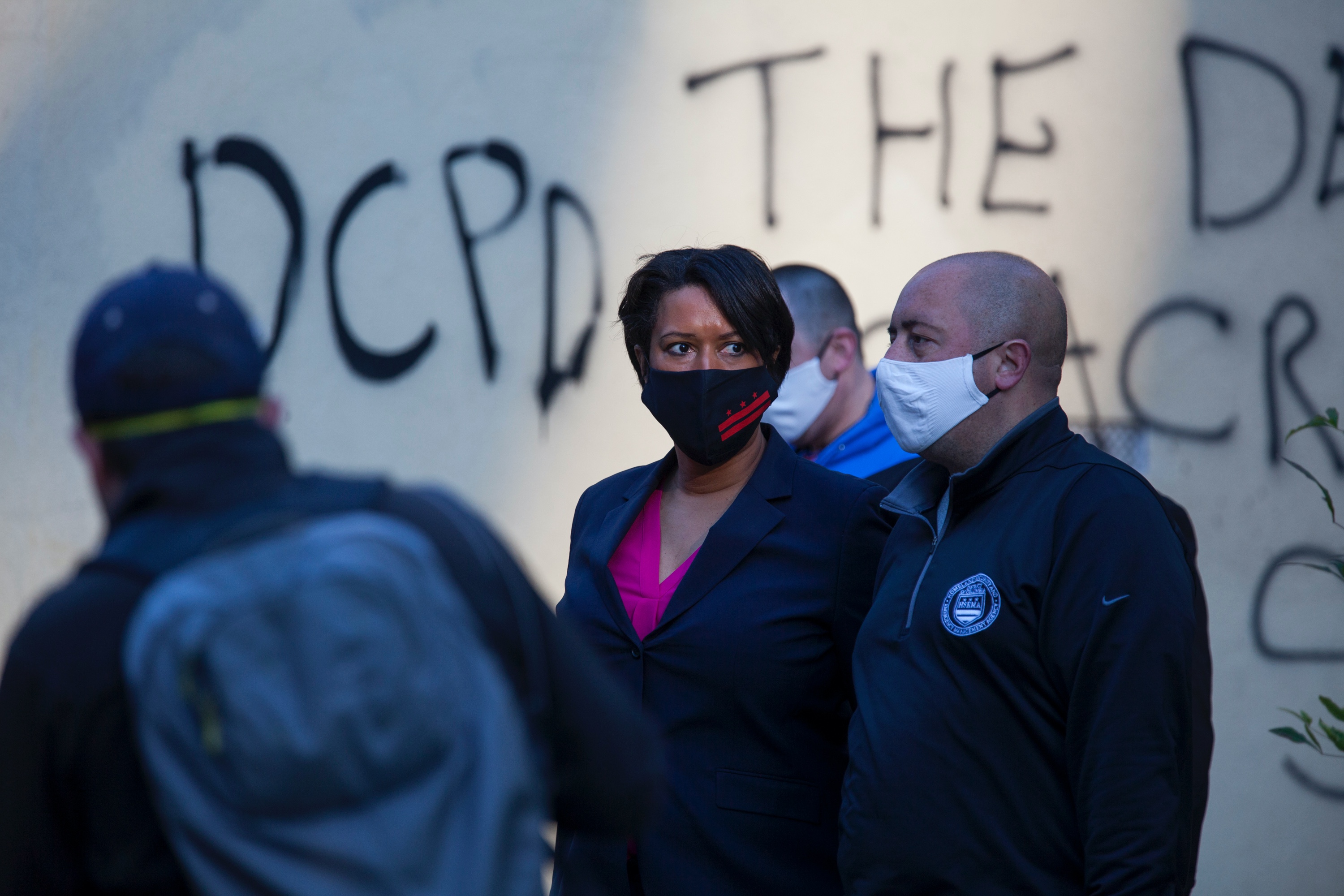
At a press conference this afternoon, Mayor Muriel Bowser and DC Police Chief Peter Newsham said the change from the last two nights’ curfew of 7 p.m. is because the protests in the city on Tuesday were generally less chaotic than on Sunday and Monday nights. More than 5,000 people are believed to have joined the Tuesday demonstrations, which happened near Lafayette Park, the Lincoln Memorial, and other downtown areas.
“The curfew gives the police the ability to stop the violence we saw two nights during this event, the significant violence we saw,” Newsham said. “If you have groups that are clearly peacefully protesting … those groups are going to be allowed to peacefully protest. If there are indicators within a group that we believe may rise or increase in volatility … it’s our responsibility to ensure that the group’s behavior is stopped.”
Nineteen people were arrested during the demonstrations Tuesday and overnight, according to the police chief, down from 288 on Monday and 92 on Sunday. Most of Tuesday’s arrests were for curfew violations, while 11% were for felony rioting and another 11% for burglary.
The plurality of arrestees — 41% — were D.C. residents or had “some association” with the city, Newsham said. Thirty-five percent were from Maryland and 14% from Virginia.
Newsham said police expect another round of peaceful protests but are sticking with a curfew “out of an abundance of caution.” He pointed to a controversial and high-profile confrontation between officers and protesters at Swann and 15th streets NW on Monday night, during which multiple protesters were welcomed into residents’ homes and, Newsham acknowledged, police deployed pepper spray. “The specifics of that pepper-spray deployment will be investigated by our internal affairs bureau, as is each use of force by our officer,” he said Wednesday. The police chief added that he had no evidence to support allegations that protesters were “decimated and beaten” during the confrontation.
Ultimately, D.C. police arrested 194 people on Swann Street, according to Newsham. He said that before the incident, police monitored a group whose behavior “was consistent with” what preceded violent conduct during the previous nights of demonstrations, such as the use of “certain projectiles.” The confrontation occurred starting at roughly 9 p.m., two hours after the city’s curfew that night and, Newsham said, after officers had warned the protesters about violating it.
“This was an arrest of significance, a mass arrest, which is something we don’t like to do but feel like we have to do when we feel like we could have a threat to public safety,” he said. “While effecting the arrests on Swann Street, there were reports of arrestees kicking in doors on that block.”
On Wednesday, Bowser also addressed the U.S. government’s deployment of federal law enforcement agents in the District. She said her administration had requested help from the D.C. National Guard, the Federal Bureau of Investigation, and the Drug Enforcement Administration, but not the other agencies whose officers have appeared in recent days near the White House and along the National Mall.
Newsham confirmed that while U.S. Customs and Border Patrol agents were activated in D.C., it wasn’t at the District’s request. “We are not giving orders to federal police, of any sort,” Bowser noted.
Later in the afternoon, the Associated Press, citing “senior defense officials,” reported that active-duty troops deployed by the Trump administration to the D.C. area were beginning to head back to their home base. But Defense Secretary Mark Esper later reversed that decision after a meeting at the White House, Army Secretary Ryan McCarthy tells the AP.
“It is our intent at this point not to bring in active forces, we don’t think we need them at this point,” McCarthy said during an interview with the AP. “But it is prudent to have the reserve capability in the queue on a short string.”