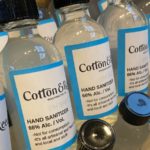
In early April, as the coronavirus pandemic transformed business operations across the city, Jordan Cotton opened a pick-up window at Cotton & Reed, the rum distillery he co-owns in Union Market.
One day, he spotted a long line of customers clamoring outside. But they weren’t there to buy rum.
“They were there for hand sanitizer,” Cotton says.
Cotton & Reed was one of five local businesses — four distilleries and a coffee roastery — that the D.C. government commissioned to produce mass amounts of hand sanitizer during the early days of the crisis, when some people were panic-buying cleaning products and emptying store shelves. Hand sanitizer in particular became a coveted item after the U.S. Centers for Disease Control and Prevention promoted forms of it with high levels of alcohol as a way to combat COVID-19.
The five businesses ultimately produced more than 28,000 gallons of hand sanitizer for the city, receiving more than $984,000 in District funding, according to Mayor Muriel Bowser’s office. Besides Cotton & Reed, Republic Restoratives, One Eight Distilling, Don Ciccio & Figli, and Compass Coffee participated in the effort, with Republic Restoratives churning out most of the total: nearly 22,000 gallons, at a cost of more than $528,000. An emergency exemption from the federal Tax and Trade Bureau allowed these businesses to make hand sanitizer in house, and all five also sell their products to the general public.
The government-ordered hand sanitizer went to D.C.’s frontline workers, including street cleaners hired by the city’s business improvement districts, as well as public agencies, including the D.C. Council and the D.C. Board of Elections, which was then preparing for the June primary.
But since the spring, the city hasn’t asked the five businesses to make any more hand sanitizer. Meanwhile, large companies have beefed up production of their own hand-sanitizing products, chasing widespread demand and cutting into the local businesses’ customer base.
As a result, two distilleries — Don Ciccio and One Eight Distilling — stopped making hand sanitizer. The former says the production process was too expensive, while the latter says its hand sanitizer didn’t sell well after the initial boom.
Four of the businesses — Don Ciccio, Republic Restoratives, Cotton & Reed, and Compass Coffee — say they continue to make minor profits from selling their hand sanitizer directly to customers, including other local businesses. This has helped boost their bottom lines as their usual sources of revenue remain hamstrung by the pandemic.
While D.C.’s COVID-19 restrictions now permit them to open indoors at half capacity, Cotton & Reed, Republic Restoratives, and One Eight Distilling have kept their tasting rooms closed because the owners don’t think reopening them would be safe for staff and customers, with the coronavirus still circulating in the city. The same goes for Compass Coffee, a handful of whose locations remain open for carryout. Don Ciccio has reopened its tasting room, although its bar remains closed under the District’s Phase Two reopening rules. Both it and Cotton & Reed are offering outdoor-patio service.
One Eight Distilling halted its hand-sanitizer production in July and currently has more than 10,000 gallons left. The distillery, which is located in Ivy City and manufactured more than 4,200 gallons of hand sanitizer for the District government, is seeking to sell or donate the remaining product.
“To get squeezed out and have the market drop out from under us, I guess that’s the nature of things,” says Sandy Wood, the cofounder and CEO of One Eight. “We have a lot on hand and we’re not happy about it.”
Moving inventory during a pandemic
On March 25, Mayor Bowser ordered that nonessential businesses shut down to prevent the spread of COVID-19. Among them was One Eight Distilling — forced to close its popular tasting room and suddenly deprived of the usual orders from bars and restaurants for its gin, vodka, and whiskey.
The distillery suspended liquor production for four months and went all in on hand-sanitizer manufacturing, supplying establishments that were still open for take-out as well as the D.C. government.
At the beginning, it charged $70 per gallon. A shortage in ingredients and packaging for hand sanitizer — along with the fact that the distillery made the stuff from scratch with local corn grains — drove up the price. One Eight later cut its prices by buying beverage-grade ethanol from an industrial manufacturer.
“They made it very, very cheaply, and they retooled it to make ethanol that was acceptable by [U.S. Food and Drug Administration] standards,” explains Wood, the distillery’s CEO.
Several local breweries also pitched in. DC Brau, Right Proper, Hellbender, 3 Stars, Anxo Cidery, and Port City Brewery donated expiring beer to One Eight, which distilled the beer into hand sanitizer. This helped the distillery cover its overhead and general expenses.
“We hoped that we would make some profit there to help balance the books,” Wood notes. “At this point, we’ll be happy to get out breaking even.”
Currently, One Eight is filling small-scale orders and donating what hand sanitizer it can to numerous nonprofits in the area, including Bread for the City, Howard University Hospital, So Others Might Eat, and Wooly Mammoth Theatre Company. Wood says so far the distillery has donated more than 200 gallons.
While One Eight’s wholesale business with liquor stores is rebounding, it’s not enough to offset other losses. Wood has had to lay off three employees, despite receiving loan relief through the federal Paycheck Protection Program and the Economic Injury Disaster program. At present, he employs six people.
He hopes to restart outdoor service once coronavirus cases drop. “We’re looking to survive the closure of the tasting room and how much longer that will be,” Wood says.
Government assistance ‘came and went’
With the closure of Republic Restoratives’ tasting room in Ivy City, the women-owned distillery opens only for drop-in liquor sales these days, says CEO Pia Carusone.
The distillery started making hand sanitizer March 13 — around the time COVID-19 took root in the D.C. area. That helped support the business even though, as Carusone says, the pandemic “completely destroyed” its wholesale liquor business. Republic Restoratives retains 11 full-time employees, although it’s burned through a PPP loan and a $10,000 grant from D.C. fell short of one month’s rent.
“It’s like, that came and went,” says Carusone. “We appreciate it, but if you’re a business like us, you’ve got the landlord calling every month, you’ve got the bank calling every month. So we’ve got lots of money going out every month.”
Republic Restoratives completed the city’s massive order of hand sanitizer and is now filling wholesale orders for customers like Glen’s Garden Market, a telecom company, and election agencies in Maryland and Virginia as well as bars and restaurants.
Carusone, who at one point caught COVID-19, says the demand hasn’t tapered off that much since the spring. Her business plans to debut a spray-top version of its hand sanitizer soon.
Cups of coffee and gallons of hand sanitizer
More than five months into the pandemic, D.C.-based chain Compass Coffee is still producing its “Simple Sanitizer.” At the start, the District ordered more than 100 gallons of hand sanitizer from Compass, with Arlington County also making a procurement.
In all, Compass says it has manufactured 50,000 gallons, supplying residents, businesses, and nonprofits in addition to those governments. The sales have in part allowed the chain to rehire 20 employees after laying off 150, and Compass hopes to rehire even more employees once its cafés reopen, according to Kuran Malhotra, the chain’s corporate development director.
Eight of Compass’ 12 locations in the D.C. area are currently open only for carryout. Compass continues to make hand sanitizer because it’s the “right thing to do” with the pandemic ongoing, Malhotra says.
“We have all this professional equipment and at the end of the day, we’d rather use that to provide something that’s helping the community and actually contributing to making people feel more comfortable,” he adds.
‘It’s becoming the salt and pepper’
Don Ciccio & Figli President Francesco Amodeo broke the mold with his distillery’s blue hand sanitizer, pumping out liquid and gel versions. He added an “Amalfi Coast” scent with essential oils to enhance the smell and give it a calming effect.
“So that’s why it’s called Acqua Marina,” the master distiller says of his hand sanitizer. “We cannot just do anything clear, you know. You have to do it right.”
In late March, while Amodeo waited for new alcohol he’d ordered, Don Ciccio launched hand-sanitizer production with flavored, food-grade alcohol. Supply-chain issues increased his costs, causing him to suspend manufacturing of Acqua Marina in May.
“It doesn’t make sense for us to make the sanitizer when it costs to make $120 a gallon,” says Amodeo. “[Then,] how much do we sell the sanitizer at?” The master distiller opted for pricey food-grade alcohol instead of gambling with industrial alcohol because he says the latter had a “horrible” smell he couldn’t mask.
Don Ciccio ended up producing 15,000 gallons of Acqua Marina total. Amodeo sent roughly 2,700 gallons to the city for its purchase order and donated another 2,300 gallons to the D.C. Fire and Emergency Medical Services agency.
He also sold about 10,000 gallons to sports teams, local restaurants, corporations, and an electrical supply company. Amodeo estimates that he has 20 gallons of hand sanitizer left, spread across the Ivy City distillery in pumps in the tasting room and bottles on every table.
“It’s becoming the salt and pepper, only you don’t put salt and pepper on the table, you just put hand sanitizer,” he says.
After the pandemic hit D.C., Amodeo closed the distillery from March 21 to Aug. 8, although its liqueur production continued because it has national distribution deals. A PPP loan and the revenue from hand sanitizer sales helped Amodeo retain three full-time workers, while a grant from the city helped cover his other business expenses.
“We lost a lot of money being closed because the bar and [tasting] room generate a lot of revenue that’s gone in the wind,” he explains. “The hand sanitizer makes me feel a little bit better because instead of losing 100% of that amount, we felt like we lost 50%.”
Keeping hands clean—and the lights on
In the days when hand sanitizer was going fast at Cotton & Reed, the Union Market distillery, things got so hectic that the business paused rum production for nearly three months.
The distillery started making hand sanitizer the week of March 9 for customers and staff before ramping up production in April. NPR interviewed Jordan Cotton and his fellow co-owner Reed Walker about their new product at the end of March, and the publicity led to an international TV hit on CNA, a major English-language news channel based in Singapore.
“On the one hand, it’s cool because all these small distilleries have found a way not only to provide something of real value to the community but also keep people employed and the lights on,” says Cotton.
Cotton & Reed initially laid off 13 employees, and the owners stopped paying themselves. But they rehired the employees and brought on additional workers once they realized they could use the profits from their hand sanitizer to fund the positions. They also upped hours for part-timers and received a PPP loan.
“We wouldn’t be here right now if it hadn’t been for hand sanitizer,” Cotton says in an email. “The cash stopped flowing in March and we didn’t have much runway. So all our people would probably be out of work and out of healthcare right now without this.”
In addition to producing 55 gallons for the District, Cotton & Reed made some for federal agencies and contractors, liquor stores, construction companies, bars and restaurants, and Virginia municipal governments. They also donated their product to groups including the Navajo Nation and people experiencing homelessness.
At first, the distillery made hand sanitizer using its rum, but because this was too expensive, it began purchasing corn ethanol by the tanker-truck. Cotton estimates that the distillery invested roughly $500,000 in the entire operation, and says it used the profits to pay down its bank loan and back rent.
Demand has gone down since the spring, but Cotton & Reed is still cranking out hand sanitizer for big orders, mostly in gallon jugs and 2-ounce bottles. Some went to Giant Food, which sells it at more than 80 grocery stores.
“We’re like every other small business in the country,” says Cotton. “We’re just trying to figure out what’s next.”
“We’re looking ahead to some lean months when the patios go away” after the summer, he adds.
This story has been updated to correct One Eight Distilling’s current number of employees and reflect the most recent details about the donations it gave and received.