Elliot C. Williams
 Margaret Barthel
 Martin Austermuhle
 Rachel Kurzius
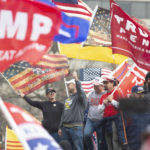
As D.C. gears up for yet another thousands-strong rally of Trump supporters today, local officials have been clear about their strategy: They’re calling for D.C.-area residents to stay away from the demonstrations, and police say they will try to keep protesters and counterprotesters separated.
While officials maintain this is the best way to keep everyone safe, critics contend that the District is ceding its downtown to extremists intent on causing harm to local people and property.
President Trump tweeted that he’ll be speaking during Wednesday morning’s events at the Ellipse, and his supporters began gathering downtown on Tuesday. By 10 p.m., police had already made six arrests related to the demonstrations with multiple weapons charges. More arrests were made later in the evening as pro-Trump crowds clashed with officers during a heated confrontation near Black Lives Matter Plaza.
The Proud Boys — a group with a history of violence and white nationalist ties, and classified by the Southern Poverty Law Center as a hate group — are among the multiple pro-Trump groups that are gathering in D.C. this week. Posts in fringe social media chats and message boards indicate that the Proud Boys intend to create chaos, as they did at rallies in November and December.
November’s rally turned from chants of “stop the steal” to outbreaks of violence in the evening, and the Proud Boys marched through the city claiming the streets as their own. The night ended with 21 arrests, a man stabbed, and a lot of questions about the free-for-all chaos that erupted in the District.
The December MAGA rally quickly descended into fights, arrests, and stabbings. Proud Boys burned Black Lives Matter banners belonging to local Black churches, an action that drew condemnation from Mayor Muriel Bowser. (A group of local black churches is calling for a police detail to protect Asbury Methodist Church, where one of the banners was burned.)
D.C. police arrested Proud Boys leader Enrique Tarrio on Monday in connection with the destruction of one of these banners, also charging him for two high-capacity firearm magazines they found in his backpack. On Tuesday afternoon, a judge banned Tarrio from D.C. until his next court date, in June. Tarrio claimed responsibility for burning the banner in interviews with media outlets and the incident is being investigated as a hate crime.
But police did not intervene to prevent the vandalism while it happened. While officers scrambled to break up fights and block off roaming groups, some witnesses said officers did little to intervene when Proud Boys targeted bystanders away from the main streets downtown.
The police department’s relatively lenient handling of the right-wing protest stood in contrast to racial justice rallies over the summer, in which demonstrators were largely peaceful, yet police responded with significant use of force. Over the summer, MPD used military tactics including kettling and arresting protestors by the dozens — tactics not seen at the recent rallies, even as many MAGA demonstrators violate D.C.’s mask mandate.
Asked about November’s pro-Trump event, outgoing D.C. Police Chief Peter Newsham expressed pride in how local law enforcement agencies handled the march and subsequent conflicts: “I was very impressed with the way that the Metropolitan Police Department was able to prevent more conflicts … It was actually quite remarkable. Not sure another agency in the country could’ve handled that.”
Newsham said that MPD’s decision not to intervene when pro-Trump protestors tore down artwork at Black Lives Matter Plaza was a judgement call for the nearby commanding officer at the scene. He added that MPD “did outstanding work” to ensure the city’s residents remained safe.
Not everyone agrees with Newsham’s assessment.
“The violence is there, and it is very clear, and when we’re out there, we see it face to face,” says Bethelehem Yirga, co-creator of the D.C. activist group the Palm Collective, who was present for the two previous MAGA rallies. She says much of the violence has been based around the Lafayette Square fence, which has been a de facto memorial for Black lives since the summer.
She saw some improvements in police’s handling of the December rallies: Yirga says police sectioned off and guarded the fence at the second event, which helped stave off some of the violence — but it wasn’t enough to deter the most provocative protestors.
For the Proud Boys, the chaos is the point, according to Cassie Miller, a senior research analyst with the Southern Poverty Law Center. Since the group’s founding in 2016, Proud Boys have been purposefully violent, picking fights with counterprotesters and then sharing videos after the fact to increase their followers, Miller says.
“They go into what are generally considered pretty progressive cities in an attempt to create violent confrontations with people like antifascist and Black Lives Matter activists in order to kind of perpetuate this narrative that the left is violent, and that it represents some sort of existential threat to the nation, and that the Proud Boys are the ones who are standing kind of in between order and chaos,” she says.
As more becomes known about the Proud Boys’ tactics, faith leaders and activists have criticized Bowser, saying that she’s urging locals to stay away from the downtown area, while allowing drunken mobs to roam the city looking for trouble. (A slew of regional leaders, including Montgomery County executive Marc Elrich, have joined the call for locals to stay home.)
“Though we understand the mayor’s concern for the residents of the city, it is galling to simply surrender our city to racist marauding mobs,” wrote Rev. Graylan Scott Hagler, of Plymouth Congregational United Church of Christ in Northeast D.C., in a statement with local clergy. “Given previous actions by pro-Trump forces the MPD should have been prepared to handle the mob in an efficient and anticipatory way.”
But what exactly can MPD and the mayor do differently?
The nation’s capital, with its hefty list of law enforcement agencies, history of peaceful marches, and strict gun laws, is known for being uniquely capable of managing protests. The sites where the Trump supporters plan to march is federal land, so it’s technically not up to D.C. to approve or deny permit applications — that’s the National Park Service’s job. Still, the recent rallies bring into question how the city handles large-scale demonstrations, especially when they feature extremists and clashes between opposing protestors.
Bowser, whose office declined to answer emailed questions from DCist, issued a statement saying that D.C. police and the D.C. Homeland Security and Emergency Management Agency are coordinating with federal agencies to protect local residents and businesses during the demonstrations. The statement warned demonstrators that D.C. law prevents the open carrying of firearms. At least four arrests at the November Trump rally were for weapons violations.
“I am asking Washingtonians and those who live in the region to stay out of the downtown area on Tuesday and Wednesday and not to engage with demonstrators who come to our city seeking confrontation,” Bowser said. “We will do what we must to ensure all who attend remain peaceful.”
Asked whether she would consider imposing a curfew for this week’s protests, as she did during multiple protests this summer, Bowser said during a press briefing, “It’s certainly a tool we will evaluate during the week.” Late Wednesday afternoon, Bowser announced a 12-hour curfew starting at 6 p.m.
One major focus of law enforcement has been to keep MAGA protesters and counterprotesters apart from one another.
D.C. Attorney General Karl Racine says MPD has been “properly focused on separating folks from that confrontation.” He mentioned the violence in Charlottesville during a white nationalist rally in 2017, which turned fatal. Reviews afterwards found that law enforcement’s failure to separate clashing groups was a major cause of the injury and death that day.
“As crazy as that sounds, white supremacists are coming into the District of Columbia in order to create chaos,” Racine told DCist/WAMU last month. “What we’ve got to do is figure out a way consistent with the First Amendment to restrict the time and place and manner of protest and make sure that the Proud Boys, when they disperse, do not have further opportunities to deface iconic properties in the District of Columbia. I do think we will have learned from what occurred just a couple weeks ago,” referring to the December MAGA demonstrations.
But keeping the groups separated comes with its own complications.
“When there are protests and counterprotests going on, what we’ve noticed is the police only face us, the counter protesters,” Yirga of The Palm Collective says. “Their backs are to the Proud Boys and the MAGAs and they are only facing us, and it kind of looks like [it’s] in a sense of solidarity [with the Trump supporters] … If they are showcasing that they’re seeing the threat from the Proud Boys as well, they would actually do a two-faced line. They would do a line facing the protesters and a line facing the counterprotesters.”
Lining up officers to separate protesters invites critiques like that, according to Chris Burbank, former chief of the Salt Lake City Police Department and a current vice president at the Center for Policing Equity. He says that tactic “just invites the focus on the cops. I think what’s best is the cops in and amongst the crowd, because then you can more effectively deal with those [violent] individuals.”
MPD declined a request for an interview about its recent tactics or the department’s plans for handling upcoming MAGA marches.
“Regardless of individuals’ political affiliations, it is the duty of MPD members to ensure the safety and well-being of all residents, visitors and demonstrators who come to exercise their First Amendment rights,” MPD spokesperson Kristen Metzger said in an emailed statement.
Newly appointed acting D.C. police chief Robert Contee said Monday that MPD would increase its presence downtown this week and would even consider closing off Black Lives Matter Plaza if necessary to prevent violence. “It could be very much a game-day assessment,” he told reporters.
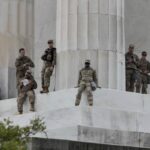
Contee repeatedly warned that firearms will not be tolerated, adding that Bowser’s office had requested the D.C. National Guard’s assistance. About 300 troops will be activated, with just 100 non-armed troops on duty at a time, to help MPD “focus on anyone who’s intent on instigating, agitating, or participating in violence in our city,” Contee said.
Some locals argue that MPD treats protestors differently depending on how the protestors treat MPD. Proud Boys, for example, have been seen taking photos with D.C. police and fist-bumping them, while Black Lives Matter D.C. openly supports the defunding of the department. Protestors and city officials alike have criticized the disparate treatment of the different protestors, saying that BLM protestors get arrested for Proud Boys-provoked violence.
MPD denies any preferential treatment. A spokesperson for the department told DCist in an email that officers are “required to be neutral in enforcing the law, however they are allowed to engage with members of the public in a variety of circumstances, such as taking photos with residents and visitors that come to the District of Columbia.”
The Proud Boys’ posture towards local police appears to be changing. Tarrio, the Proud Boys leader, said he usually gives police a heads up about the movements of the group — but during the group’s last gathering in D.C. in December, he decided against it.
“If we’re somewhere, I try to tell them, ‘Hey, we’re here, blah, blah, we’re moving there,’” he said on a recent podcast livestream. “And I think I had less of that interaction this time because I just don’t trust them to do their job.”
The group reportedly plans to use new tactics this week: “We will be incognito and we will spread across downtown DC in smaller teams. And who knows….we might dress in all BLACK for the occasion,” Tarrio wrote on Parler, a social media site popular among Trump supporters, conspiracy theorists, and far-right extremists.
Yirga, of the Palm Collective, says her group doesn’t have a specific counterprotest planned for today, but is working on ways people can take action remotely, like putting up signs in windows downtown.
“Don’t be quiet,” she says, because when people are silent in the face of fascists, “they feel as though they’re emboldened.”
Miller, of the Southern Poverty Law Center, says the D.C. community and law enforcement officials should expect more Proud Boys demonstrations beyond the planned rally this week — at least as long as false narratives over the results of the 2020 presidential election continue to swirl.
“Like any other group like this, they’re really political opportunists. And so what they want to do is insert themselves into this narrative,” Miller says. “And so that means D.C. is their focus and it is likely going to remain their focus for the foreseeable future.”