Colleen Grablick
After a sharp decline in February, COVID-19 infections are rising again in Virginia and Maryland as officials across the region ease restrictions on businesses and ramp up vaccination efforts.
The average rate of daily new cases in Maryland and Virginia has increased by 10% and 9%, respectively, over the past week, following the states’ rollbacks on coronavirus restrictions, according to the Washington Post’s regional coronavirus tracker. Meanwhile, D.C., which is loosening a slew of restrictions on Monday, saw its average daily infection rate decline by 27% over the past seven days.
Those trends in the region follow a national pattern in recent weeks as governors move to relax public health ordinances. Infections are high and staying high in 22 states — including Maryland and Virginia — according to the New York Times, and all three local jurisdictions have reported cases of the more contagious coronavirus variants.
Increasing infection rates also come despite the region’s progress in vaccinating residents. Last week, Maryland Gov. Larry Hogan, Virginia Gov. Ralph Northam, and D.C. Mayor Muriel Bowser all announced optimistic vaccine outlooks after President Joe Biden pledged that every adult would be eligible for a vaccine by May 1. Virginia encouraged local health departments to move into Phase 1C of its rollout, Maryland opened vaccine eligibility to all residents over age 60, and D.C. opened eligibility to more groups of essential workers.
But public health experts have warned against easing restrictions too swiftly while vaccination rates move at a slower pace. In a press briefing last week, White House coronavirus advisor Dr. Anthony Fauci explained the risk that relaxing public health ordinances could pose to the progress of vaccinations.
“The concern is that throughout the country, there are a number of state, city, regions that are pulling back on some of the mitigation methods that we’ve been talking about,” Fauci said. “It is unfortunate but not surprising to me that you are seeing increases in number of cases per day in areas — cities, states, or regions — even though vaccines are being distributed at a pretty good clip of 2 to 3 million per day. That could be overcome if certain areas pull back prematurely on the mitigation and public health measures that we all talk about.”
As of Monday, March 22, Maryland recorded an average rate of daily new cases per 100,000 residents of nearly 16— much lower than the infection rate recorded during the January surge, but well above the metric recorded for much of the summer and fall, when the state maintained stricter coronavirus orders. The average positivity rate, which measures the number of positive cases out of all tests administered, has surpassed 4% in recent days, after staying below 4% for several weeks.
The increase follows Gov. Larry Hogan’s move to lift capacity limits on restaurants, gyms, and other businesses on March 12, citing (at the time) improving health metrics and the increasing rate of vaccinations.
“The time is right,” Hogan said when announcing the rollbacks, making Maryland the first local jurisdiction to do away with all indoor dining restrictions.
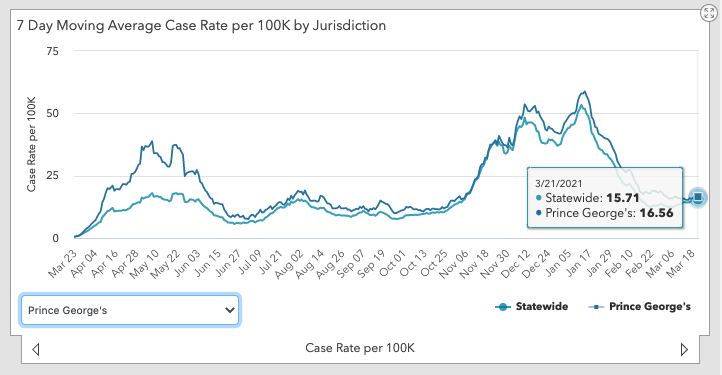
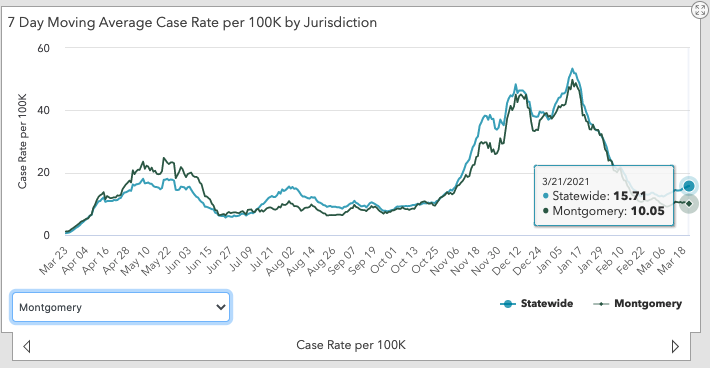
Prince George’s and Montgomery counties — which did not follow Hogan’s directive to loosen indoor restrictions — haven’t seen infections increase at the same rate as the state.
Prince George’s County has maintained a case rate above that of the state for nearly the entire pandemic, but in recent weeks the gap has narrowed. On March 1, the county reported an average case rate per 100,000 residents of 17.2, compared to the statewide rate of 13. On March 22, the county’s case rate was 16.7, compared to the statewide rate of 15.7. Instead of completely lifting capacity limits on indoor businesses, which Hogan recently permitted statewide, Prince George’s County increased its limit from 25% to 50%.
Montgomery County officials, critical of Hogan’s leniency, issued a more measured reopening order similar to Prince George’s County, ending curfews on alcohol sales and increasing indoor capacity limits on most restaurants and businesses from 25% to 50%. The county has seen its average infection rate stay around 10.0 since mid-March.
While hospitalizations in the state remain lower than during both the spring 2020 and January peaks, Maryland is currently one of six states where new deaths are increasing, according to the New York Times. The average daily recorded death count increased by 35% over the past seven days, per the Washington Post’s tracker.
The rolling average of new cases in Virginia has likewise ticked up in March — reaching 1,443 as of Monday (a little more than one week ago, the metric had dipped below 1,300). While still a marked improvement from the averages of 5,000 or more daily cases in January, the average number of new cases remains higher than at any point reported last spring, summer, and early fall.
On March 1, Gov. Ralph Northam rolled back a flurry of restrictions imposed in November and December of 2020 as cases increased ahead of a feared holiday spike. The modified curfew ended, the 10 p.m. limit on alcohol sales was pushed back to 12 a.m., and outdoor gatherings can now include 25 people, up from the previous order of 10 people — but the capacity limit on indoor dining remains at 50%.
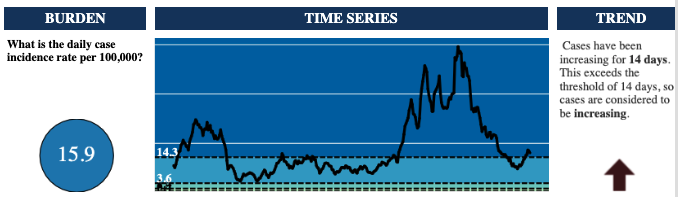
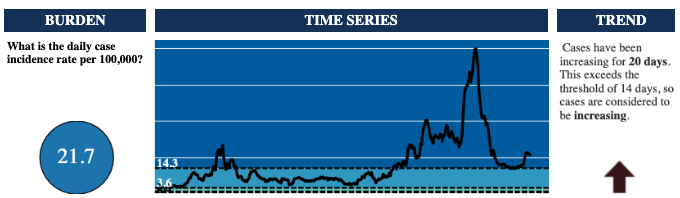
In the Northern Virginia suburbs, the city of Alexandria and Loudoun County have seen especially large increases in their coronavirus metrics in recent weeks. In Alexandria, the average number of new cases per 100,000 residents increased from 9.4 on March 10 (the lowest that metric had been since November) to 16 on Monday, March 22. Loudoun County, which saw its average new infection rate dip below 14 for the first time since mid-November on March 7, is now reporting a rate of 22 cases per 100,000 residents.
Despite the rising case counts, the commonwealth continues to report a decrease in hospitalizations and deaths since the dramatic spikes in January. As of March 22, Virginia’s seven-day average of new deaths was 27, compared to nearly 200 at the beginning of the month, and the number of patients hospitalized with the virus dropped below 1,000 for the first time since mid-October on Monday.
Meanwhile, in D.C. — which is changing several of its pandemic-era operations on Monday — coronavirus cases have declined this month, except for a backlog in reporting that led to a brief spike in mid-March. As of March 22, the city reported an average daily case rate per 100,000 residents of 16.0, just slightly above the 15.0 threshold indicating substantial community spread. (D.C. dipped briefly into the moderate community spread zone in late February.) The city’s rate of transmission, which estimates how quickly the virus is spreading by estimating the number of people infected from one positive case, has stayed in the “moderate” range since late February, and hospitalizations have also consistently dropped throughout March.
Even so, the city’s seven-day average of new cases remains slightly above 100. Throughout much of June, July, August, and September, the city reported an average well below – or even half of that — as D.C. operated under tighter COVID-19 precautions.
Bowser’s new order going into effect Monday will increase the limit on outdoor gatherings to 50 people, and the city has granted permits for both Nationals Park and Audi Field to host 5,000 and 2,000 fans at home games, respectively. Indoor dining can increases to 25% capacity or 250 people, and alcohol can be sold until midnight.