 Jordan Pascale
Update, Oct. 14, 5 p.m.: D.C. Mayor Muriel Bowser has walked back her initial claim that Maryland and Virginia rejected her request for a ticket reciprocity deal to help crack down on out-of-state drivers who speed and run red lights in the city. An updated story is here.
Virginia and Maryland’s governors say they won’t allow their respective DMV’s to hold their state’s drivers responsible for outstanding tickets and fines from D.C.’s traffic cameras, according to a new report filed with the D.C. Council this week.
Mayor Muriel Bowser told lawmakers that “both jurisdictions declined to enter into a reciprocity agreement based on the determination that such an agreement would negatively impact the customer service of their motor vehicle offices.” It’s unclear how far negotiations went as spokespeople for both governors say they are unfamiliar with the request and are looking into the matter. Bowser’s press office is also looking into it.
For years the council had been seeking a way to force out-of-state drivers to pay their tickets or face some sort of accountability for driving unsafely in the city. One aspect of the 2020 Vision Zero Omnibus Bill to reduce traffic deaths required Bowser to seek some sort of reciprocity agreement with Virginia and Maryland, under which drivers from those states could be forced to pay outstanding D.C. tickets. (And D.C. drivers would also be on the hook for traffic camera tickets from Maryland and Virginia.)
Tickets written by police are subject to reciprocity under the Non-Resident Violators Compact, in which 44 states (including Maryland, Virginia, and D.C.) participate. But the automated ticket cameras are not included under those agreements.
D.C. Deputy Mayor Lucinda Babers declined an interview on how the negotiations went. The office of Virginia Gov. Ralph Northam (D) said they have no record of the request, but was seeking more information from departments. Mike Ricci, a spokesperson for Maryland Gov. Larry Hogan (R), said he was unfamiliar with the proposal and was checking to see if it rose to the level of the governor’s office.
The District mails out about 1.3 million red light and speed camera tickets a year. Marylanders had 1.1 million outstanding tickets worth $240 million in fines as of last year, according to a Washington Post story. Virginians haven’t paid nearly 670,000 tickets, about $133 million, while D.C. drivers had 354,000 outstanding tickets worth about $64 million.
“That is a lot of money that Virginia and Maryland drivers owe the District, but more importantly than that, we have drivers who are creating danger on our streets,” says D.C. Councilmember Charles Allen (D-Ward 6). “And without the ability to have reciprocity, without the ability to have those tickets be paid, I think it creates a sense of impunity among drivers that there are no consequences, that there are no real repercussions [to breaking our laws].”
It’s unlikely D.C. would have been able to get license suspensions from other states as Maryland has a new law that doesn’t allow suspensions for not paying tickets, as do Virginia and D.C. But Allen said the consequence of being forced to pay a $100 fine through some other mechanism in a reciprocity agreement would make people think twice about how they drive their vehicle.
“We’ve tried to work hard on thinking about issues around equity, around affordability, and making sure that we don’t have policies in place that harm, low-income workers who, who may have a ticket and face escalating fees,” Allen said. “This is different, when you’re talking about hundreds and hundreds and sometimes thousands of dollars of speeding tickets for dangerous driving, you don’t belong on the streets. Sorry, you are making our streets less safe, more dangerous.”
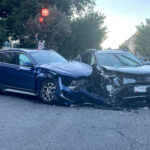
The issue was highlighted this week when a driver in a vehicle with temporary Virginia tags hit and seriously injured a dad and his two young daughters in a crosswalk in D.C.’s Congress Heights neighborhood. The vehicle had accrued $900 worth of tickets in D.C. in the past three months: four for speeding, one for running a red light, and one for turning right on red when they weren’t supposed to. Twitter users will often use the DMV’s plate checker to look up how many fines cars involved in crashes or bad driving have and often find many unpaid tickets.
Allen was disappointed with the news of no agreement.
“As elected officials as politicians, [that report says] they don’t want to have their residents pay, but I’m sorry, this is about safety,” Allen said. “And it’s about the region’s safety. To my D.C. residents, if you’re racking up tickets in Virginia and Maryland, I believe you should pay those as well.”
The state of Maryland adopted a Vision Zero goal as well in 2019. Several Virginia localities have done the same. But Allen says adopting those goals and having the political will to focus on safety over convenience are two different things.
Bowser’s letter says the administration will now “explore alternative options for achieving the ultimate objective without involving the other jurisdictions’ motor vehicle offices.” D.C. recovered $44 million during a recent ticket amnesty program that waived late fees and penalties, with the majority of the money coming from Marylanders. Bowser also wrote that Virginia will have a new governor in January, which could bring change.
This story was updated with comment from the Virginia Governor’s Office.