Martin Austermuhle
When D.C. resident David Fridie needed a rapid COVID-19 test this week, he didn’t scour supply-starved local pharmacies or try his luck online. Instead he just drove over to the Capitol View Neighborhood Library in Southeast D.C.
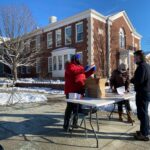
“I walked right up. There were like three people in front of me. There was a security guard that was right there at the door. All you had to do was show your ID I think she barely looked at it, to be honest with you. And she just handed me the test,” he says. “It was the quickest thing ever.”
Amid a record-shattering spike in COVID-19 cases (more than 9,000 new cases were reported over the Christmas weekend) that could again strain hospital capacity and throw a wrench in school reopening plans next week, D.C. officials are drawing at least some praise — and a fair share of regional jealousy — for their daily distribution of rapid test kits at public libraries.
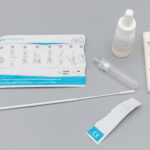
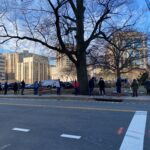
Launched by Mayor Muriel Bowser last week as part of a suite of policies responding to the increasing COVID-19 caseload, the program offers 1,000 free antigen test kits a day at each of eight libraries — one in each ward of the city. (On weekends, the kits are given out at a smaller number of firehouses.) While last week’s first day of distribution was initially beset by confusion and long lines, many residents say the experience since then has been easy, convenient, and largely without significant delays.
“It was fairly seamless,” says Arnebya Herndon, who picked up tests at the Anacostia Library, which is close to where she lives.
“I’m so grateful D.C. is doing this. It mirrors the experiences of friends in England (where we lived for three years) where the NHS is giving out free tests, or Germany, where schools hand them out. It is such an effective and wise way to handle schools, [apartments], and group settings,” wrote Kristin Jamieson, a Capitol Hill resident and mother of four who earlier this month spent $150 buying rapid tests for her family.
An online tracker of test supply at each library has also eliminated the guesswork for many residents heading to get a test for themselves.
The program’s rollout came at a critical time, as holiday demand for rapid tests spiked and supply at many pharmacies dried up. (The shortages prompted President Joe Biden to purchase enough rapid tests to send one to anyone who requests it, though not until next month.) It also stands as a regional outlier, offering an easy supply of rapid tests to D.C. residents while surrounding counties have none to give or can only provide them to specific groups of people. Montgomery County, for example, is only distributing rapid tests to those who are homebound, experiencing homelessness, or at increased risk of contracting COVID-19. In Alexandria, several libraries distributing antigen tests on Tuesday quickly ran out.
That’s made some D.C. residents a source for friends and family who live outside the city. Jeff Iannuzzi, who lives in Logan Circle, has picked up tests for himself — and had a relative in Montgomery County inquire about whether she could get some for herself.
“She was asking to see if D.C. was checking checking IDs, and I was like, ‘Yes, they are absolutely checking for proof of residency,'” he says.
Herndon had a sister in Prince George’s County and a friend in Montgomery County similarly ask her if she could spare a rapid test or two — which she did. “They have none,” she says. “I’m glad to be in a position to help someone who can’t.”
But there have still been concerns around access to rapid tests. Some Ward 6 residents have complained that their designated distribution point is at the Watha T. Daniel Library in Shaw, far away from many of its residents. Others say that the hours of distribution — generally from 10 a.m. to 6 p.m. — aren’t practical for people with jobs that require on-site presence during the day, and that the requirement for ID, lease, or utility bill to prove residence could be an obstacle for unhoused residents.
And while Fridie says getting tests for himself was simple, the same can’t be said for his homebound 104-year-old great-grandmother.
“Even though she isn’t leaving the house, we still want to be sure we could test her at least weekly, as well as some of the home health aides that are coming into the house. The issue is that she cannot go get tests. I wish there was a way that the Department of Health could send these tests directly to our seniors or those who are homebound or those who do have diseases where, you know, standing in line right now is not the safest bet,” he says.
There is one D.C. program — though not well advertised — that does this, called Ready Responders. Testers come to a person’s home from 8 a.m. to 8 p.m. to conduct an antigen test; the phone number to request a visit is (202) 602-0814.
There also remain broader concerns with testing capacity. The free PCR tests (more accurate tests that must be sent to a lab for results) that D.C. has been distributing at libraries in recent months have been tougher to come by — the city has been asking for volunteers to help put those testing kits together — and lines at testing facilities in and around the city are often long. And it remains unclear whether lines for rapid tests will worsen once D.C. residents return from holiday travel and prepare to send their kids back to school.
At a press conference held by Mayor Bowser on Wednesday, health officials said they had distributed a total of 108,000 antigen tests so far, and 16,989 residents have reported their test results to the city. Officials also reminded residents who test positive to begin isolating for five days, to report their results online, and to be prepared to have a contact tracer call them. After five days, they should still mask around others for an additional five days (including around members of their household), even if they are asymptomatic or have mild symptoms.