Martin Austermuhle
In the midst of the June 2020 racial justice protests that rocked D.C. and many other American cities, Mayor Muriel Bowser got a fateful call: Then-president Donald Trump was considering commandeering the Metropolitan Police Department as part of a broader plan to crack down on demonstrations, some that had turned violent.
“I was getting out of my car to go into the house, and I am stopped literally in my driveway taking this call from [then-D.C. Police Chief Peter Newsham]. And I got back in the car,” said Bowser, who quickly started making her way back to the Wilson Building downtown. On the way, she jumped onto a second call with senior White House officials about the possibility of federal officials taking over MPD. “I’m telling them it would be a complete disaster, [that] we’re going to lose the city. I was concerned that we would have a riot in the District. A real riot.”
Bowser’s recollection of the heated summer of 2020 and Trump’s response to it was included in a Jan. 2022 interview conducted by the Select Committee to Investigate the Jan. 6 Attacks on the U.S. Capitol and publicly released in late December as part of a large tranche of testimony and depositions from dozens of federal officials, presidential aides, activists, and Trump’s allies.
While much of the testimony focused on the forces that fueled the insurrection and the government and police mishaps that failed to prevent it, the committee’s conversations with both Bowser and D.C. Police Chief Robert J. Contee III drew a direct line between the federal government’s aggressive approach to the June 2020 protests in D.C. and the much more sluggish response to the insurrection, which left hundreds of MPD officers rushing to the U.S. Capitol while federal officials dithered over how and when to redirect the National Guard there.
The 2020 protests
In 2020, Trump, who was furious about the protests that popped up in dozens of cities in the wake of the police murder of George Floyd, urged a harsh and unrelenting response. But as Bowser told the committee, the only place in the country where he had free rein to order that was in D.C. That’s because D.C. isn’t a state, and is ultimately under the control of Congress and the federal government. The provision allowing the president to federalize MPD, Bowser told the committee, “hearkens to an ugly segregationist past.”
“Ultimately the president did not want these protests happening in any American city,” she said. “And the place he could stop it was D.C.”
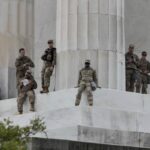
While Trump never did federalize MPD, he did order a large National Guard deployment and also placed large numbers of armed federal officers from a number of agencies (including the Federal Bureau of Prisons) around downtown D.C. The use of those officers was a shock to Contee, he told the committee.
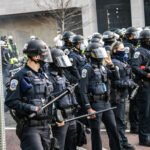
“There would be outside of where my office is, you know, 35, 40, 50 federal agents walking down the street with long guns with tactical pants on and a T-shirt … and the first thing I am thinking as the chief of police of a major city, like, when do we bring long guns to demonstrations?” said Contee, who was assistant chief of MPD at the time. “We’ve dealt with riots and all kinds of stuff here in the nation’s capital, and, I mean … you will not see Metropolitan police officers on the west lawn of the Capitol with long guns deployed.”
The D.C. National Guard, which was controlled by federal officials, went even further, flying two helicopters low off the ground above a group of protesters. The Army later concluded that the helicopters had been misused, but for many, they became a symbol of the overly aggressive federal response to the racial justice protests in D.C. in June 2020.
The 2021 insurrection
Ahead of the planned Jan. 6 meeting of Congress to certify the results of the Nov. 2020 presidential election, Bowser requested that federal officials allow her to deploy a small number of unarmed D.C. National Guardsmen to help with traffic control and crowd management. (Unlike the 50 states, where the governor controls their National Guard, in D.C. any such local requests have to be made through the federal government.)
Bowser told the Jan. 6 committee that the limited request would allow MPD to fully focus on managing protests and any possible disturbances in the city, while guardsmen would focus on logistics. She was later criticized (including by Trump) for only having asked for a small number of guardsmen, and having them unarmed, but she said that even a large contingent of armed National Guard troops wouldn’t be properly prepared to handle protests and disturbances that could break out.
“There’s absolutely a difference in training,” she said. “And I don’t know any law enforcement person who would suggest that urban disturbances aren’t best handled by the police.”
Bowser and Contee both told the committee that the events of 2020 didn’t motivate them to make a limited request for National Guard assistance on Jan. 6; both said they simply felt MPD officers would be better equipped to handle any issues that arose with the pro-Trump protests. But they also said they assumed the officials in the Department of Defense were still smarting over criticism from the response to the 2020 protests, and wanted to ensure a repeat didn’t happen.
“I think we assumed that the guard had been badly embarrassed in June and that especially I think they were undergoing their own investigation about the use of their helicopters. And I assumed that they wanted tighter rein on what the guard did for that reason,” Bowser said.
And that tighter rein was made clear to Contee: Not only was he told that the National Guardsmen would not be allowed anywhere east of Ninth Street NW, but that any change in deployment would have to be approved by the Secretary of the Army, a provision Contee said he had never experienced before. “I felt like that was an unnecessary restriction,” he told the committee.
Contee also told the committee that Secretary of the Army Ryan McCarthy had offered him an alternative: Instead of National Guardsmen, would he want other federal officers deployed around D.C.? For the police chief, though, the experience in 2020 made that an unacceptable option.
“[McCarthy] had concerns about deploying the National Guard for this event. He talked about the optics of the event, having boots on the ground. As an alternative to the National Guard, he suggested that we consider deploying federal officers to the streets of the District of Columbia,” he said. “And, of course, in my mind, I’m thinking about the federal officers that were deployed before, and that was not what we wanted here in the District of Columbia.”
In another answer to a question from the committee, Contee said deploying armed federal officers not trained in handling civil disturbances would have been a “recipe for disaster.” He also added: “I don’t need military guys with long guns ushering people coming out of the Metro or on traffic posts directing traffic. There was no need for firearms.”
Once the Capitol was overrun, Contee — who started his role as chief just days before the insurrection — said MPD was quick to respond, ultimately deploying more than 800 officers to help fight off pro-Trump protesters and clear the Capitol. It would be hours until the National Guard appeared, largely because of apparent bureaucratic inertia and hesitation at the federal level.
“If they were under my command, they would have been there as soon as MPD was there,” said Bowser, raising a recurrent concern for D.C.’s leaders — they don’t have direct control over the D.C. National Guard.
Ultimately, both Bowser and Contee told the committee that in the future, lines of authority have to be streamlined to allow for federal forces like the National Guard to pivot more quickly when the need arises.
“I would hope that in the future if there is a crisis on hand that it wouldn’t take several phone calls and approvals and this and that to re-mission the National Guardsmen who are assigned to the District of Columbia; if we need them anywhere in the federal landscape or federal footprint, that we could quickly send those people where we need to send them to address whatever the issue is and deal with the administrative stuff on the back end of the crisis,” said Contee.
Bowser also recommended that the certification of the presidential elections be designated a National Special Security Event on par with the State of the Union and inauguration, which would set in place new security planning and preparation. In its final report, the Jan. 6 committee proposed the same.
Still, some things have not changed. A bill giving D.C. leaders control over the National Guard did not pass, and neither has a separate measure that would strip the president of the authority to federalize MPD.
Previously
District Of Cops: Like It Or Not, The Feds Have Lots Of Control Over Police In D.C.