Colleen Grablick
Enis Jevric, the Metropolitan Police Department sergeant who fatally shot 27-year-old An’Twan Gilmore in 2021, has been charged with second-degree murder, according to the U.S. Attorney’s Office.
Jevric appeared in federal court Tuesday, facing three charges: one civil rights violation for “willfully depriving” Gilmore to be free from the use of excessive force; a violation of federal law for using a firearm to commit second-degree murder; and second-degree murder. The three offenses carry a maximum penalty of life in prison, according to the U.S. Attorney’s Office for D.C.
It marks one of the rare instances that a D.C. police officer has been charged with murder for killing someone while on duty. Only one police killing in recent memory has led to a conviction; in December 2022, D.C. police officer Terence Sutton was convicted of second-degree murder in the death of 20-year-old Karon Hylton-Brown, who died after a police chase in 2020. Sutton and his supervisor, Lieutenant Andrew Zabavksy, were also found guilty of obstruction and conspiracy, and both have filed motions to have their cases re-tried.
“We thoroughly investigate every incident where one of our fellow citizens dies during an interaction with law enforcement,” U.S. Attorney Matthew M. Graves said in announcing Jevric’s indictment on Tuesday. “We have found that most officers use force only when necessary. In these investigations, we follow the evidence and the law. In the overwhelming majority of these cases, criminal charges would not be appropriate. But when an officer willfully disregards the safety of a citizen he is sworn to protect, he violates the trust placed in him by virtue of his badge.”
Jevric shot Gilmore 10 times while responding to a call in Northeast D.C. on August 25, 2021. According to D.C. police, officers were responding to a call about a person apparently sleeping or unconscious in a car at the intersection of New York Ave and Florida Ave. NE. Several officers arrived at the scene, and police officials said officers saw a gun in the waistband of Gilmore, the individual in the car. “To shield themselves from potential gunfire,” Jevric approached the car with a ballistic shield, D.C. Police Chief Robert Contee said in the aftermath of the killing. Jevric’s shield blocked some of the view of his body camera footage, which was released after the shooting. The video, in addition to footage taken from a bystander on the scene, did show police tapping on his window. Gilmore appeared to wake up and his car moved slightly forward. Police yelled to stop, and the car stopped. When the vehicle started rolling again, Jevric fired into the car window, killing Gilmore. (It’s a violation of MPD policy for officers to shoot at a moving vehicle, something Contee acknowledged in the days after the shooting.)
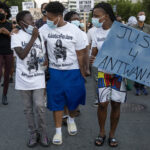
His death sparked several protests in the city, shutting down streets as friends, family members, and local activists marched for accountability. Organizers demanded a non-police-led investigation into his death, and for Jevric to be prosecuted and jailed.
“We are angry, we are hurt but we are hopeful that our justice system won’t fail us and can make things right,” LaShunna Grier, An’twan’s cousin, said on behalf of his family Wednesday. “We want the Metropolitan Police Department to know who he took away from us. He took a friend, a brother, an uncle, a cousin and a great man.”
His family has described him as a “goofy,” “lovable” man, and the type of friend who’d drop anything to pick someone up from the airport.
“We did a lot of work trying to give An’Twan Gilmore justice,” said Jay Brown, an activist who organized around Gilmore’s killing, and whose nephew, Jeffrey Price, was killed by D.C. Police. “This is just the beginning, there’s a trial … but you know, it was something I was fearful they were going to try to sweep under the rug.”
Gilmore’s family is holding out hope for a convction, but on Wednesday acknowledged, “we all have seen how history goes.”
So far this year, the U.S. Attorney’s Office has declined to bring charges in two other police killings by D.C. police. Prosecutors declined to charge Lieutenant Jason Bagshaw, an MPD commander known by activists for using aggressive policing tactics, for fatally shooting Lazarus Wilson at The Wharf last summer. The USAO also did not press charges against Reinaldo Otero-Camacho, the D.C. officer who fatally shot 31-year-old Kevin Hargraves-Shird in Brightwood Park last July. The family of Hargraves-Shird has said they plan to file a civil suit against Otero-Camacho.
Last week, U.S. Marshals shot and killed 22-year-old Alaunte Scott in Southeast D.C., marking the first killing by law enforcement in D.C. this year. D.C. police responded to the scene with body cameras on, but have not released the footage. The U.S. Marshals were not wearing cameras at the time, officials told the Washington Post. Scott’s killing occurrred less than 24 hours after D.C. police shot at a man in Columbia Heights, while investigating a call of gunshots in the area. The man, 40-year-old Savontae Dodie Perkins, was later found dead of an apparent self-inflicted gunshot wound, according to police. The officers were wearing body cameras at the time of the footage, but Perkins’ family has declined to have the footage released, according to a D.C. police spokesperson.
In January, D.C. police shot and seriously injured 38-year-old Steven Shaw while investigating an alleged assault. D.C. police officer Alex Rosario-Berroa shot Shaw, mistaking him for the suspect. The U.S. Attorney’s Office is investigating the case, and will determine whether Rosario-Berroa will face charges.
This story has been updated with statements from An’Twan Gilmore’s family.