Matt Blitz
Science-fiction writer Octavia Butler’s typewriter. Marvel’s ‘Black Panther’ superhero costume worn by Chadwick Boseman. The flight suit Trayvon Martin wore while he attended an aviation program.
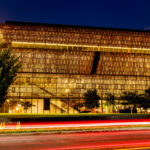
These are just a few of the more than 100 objects that are being showcased in “Afrofuturism: A History of Black Futures,” a new, much-anticipated exhibit at the Smithsonian’s National Museum of African American History and Culture (NMAAHC).
The 4,000-square-foot exhibit opened Friday and will be on view for exactly a year, through March 24, 2024. It looks to explore the concept of Afrofuturism’s history, present, and future through the performing arts, fashion, literature, science, and technology.
“[Afrofuturism] is a concept and an aesthetic that explores Black identity and life without the constraints of racism and white supremacy,” NMAAHC’s Associate Director of Curatorial Affairs Dawn Reece explained to DCist/WAMU. “So, it’s a re-envisioning of what life would be like without that in existence.”
Reece says that the field of study is in the “vanguard now,” and has recently been exemplified in television, architecture, and even in the local restaurant industry.
The term was first coined three decades ago but Afrofuturism dates back centuries which NMAAHC’s new exhibit aims to showcase.
The “Afrofuturism” exhibit is split into three sections. The first is called “The History of Black Futures” and tells the story of how enslaved peoples often looked to the cosmos and used the night sky to envision their freedom.
Artifacts, like Benjamin Banneker’s 1793 Almanack, show that while Afrofuturism may be a modern word, its roots lie in what was learned, discovered, and chronicled more than two hundred years ago.
“I hope [visitors] see the breadth and the long tradition of African Americans re-envisioning a better world from themselves,” Reece says. “That this started from the earliest days when the first enslaved were here on these shores to the present moment.”

The next two sections of the exhibit speak to how Afrofuturism has presented itself in the modern era as well as how it could help determine the future of the Black experience. These sections feature what will likely be a number of the most popular items in the exhibit.
In “New Black Futures,” the arts are a primary focus as a means for providing a vision of Black empowerment. Along with Butler’s typewriter, there’s also the colorful wig worn by Parliament Funkadelic’s George Clinton, Jimi Hendrix’s komodo, the ArchAndroid costume donned by Janelle Monáe on the cover of her 2010 album, and Sun Ra’s space harp.
“I’m taken by some of the interesting instruments by how they visually capture an Afrofuturism aesthetic and what they are put together to do,” says Reece, who was previously the museum’s music curator. “Coming from a music background, I’m very fascinated with the sounds and explorations, not only by the music itself, but the images of performers and how they present themselves in their own personas.”

The third section, “Infinite Possibilities,” explores how space, liberation, and activism all can lead to envisioning a future for the Black experience that’s without barriers.
There’s the costume of Star Trek’s Lt. Nyota Uhura, who was portrayed by Nichelle Nichols, and on its right is the flight suit worn by real-world astronaut Gen. Charles Bolden Jr.
He became the first African American to head up NASA when he was nominated by President Obama and confirmed by Congress in 2009.
To the left of both is the flight suit worn by Trayvon Martin while he attended Experience Aviation, a program put on by a nonprofit organization that provided students with STEM and aviation-based education. Martin, whose murder in 2012 was a spark for the Black Lives Matter movement, attended the program in his early teens and had an interest in pursuing a career in those fields.


“The power of seeing his flight suit up close really has us thinking about the dreams Trayvon Martin had and the dreams that we all lost the day he was killed,” NMAAHC Director Kevin Young says in a behind-the-scenes video about the exhibit.
At the end of the exhibit is one of its biggest show pieces: a superhero suit worn by Chadwick Boseman in Marvel’s 2018 movie Black Panther. There was considerable hype when it was announced late last year that the iconic costume was headed to the museum.
But it’s the concept of Black Panther and Wakanda, the technologically-advanced fictional African country depicted both in the comics and in the more recent movies, that really drives home the exhibit’s meaning.
“Technology is a big, big narrative with this exhibition, imagining what technology could do and also what technology is allowed to do,” Reece says. “Looking at comic books and action and superheroes [plus] music, architecture, and visual art… it’s about reimagining different worlds with the tools that we have at our disposal and the ones we haven’t even invented yet.
Reece believes that visitors will be “astounded” upon entering the exhibit for the first time, with the sights, sounds, and colors that make up the concept of Afrofuturism envisioned in this space. “It really takes you into the possibilities of a new world,” she says.