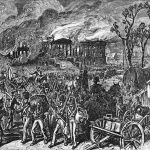
They say the terrorist attacks of 2001 on the United States was the first time a foreign force had struck inside the Continental U.S. since the War of 1812 (though there was a Japanese attack on Santa Barbara, Calif., in 1942.). So what of the War of 1812? The History Channel on Sunday is showing a special on “Mr. Madison’s War” including the burning of Washington.
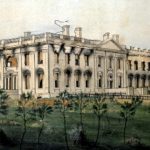
In 1814, British forces landed on the Patuxent River east of the city and crossed overland to engage American forces at Bladensburg in Prince George’s County. The Americans were routed, Dolly Madison fled the White House with the silverware and the Gilbert Stuart portrait of George Washington, and the British had their way with the city. Nearly every public building was torched as were many of the military installations and bridges crossing the Potomac and Anacostia rivers.
After the British torched the capital, they set sail down the Potomac. With the flames of the burning city clearly in sight, the citizens of Alexandria tried to bribe the British not to set the city afire. According to one website, “There was a minor disturbance in the peace of temporary British occupation of Alexandria when a team of U.S. soldiers, not having discussed their actions with any officials, decided Alexandria was giving in too easy and being disgracefully trod upon.”
If you want to learn more about the British invasion, we suggest you take a look at this online version of Benson J. Lossing’s 1869 account of the city’s burning, where we snagged this drawing of the charred Capitol.
Also you can go visit the Peace Cross, which marks the Battle of Bladensburg. It’s located just across the District line at the intersection of Bladensburg and Annapolis roads. Besides that, there isn’t too much to see in Bladensburg, but town officials may beg to differ.