 Driving down I-81 in central Virginia earlier this year, we heard something we haven’t heard in awhile: a radio station playing good music. This, and the announcement of “eco-station” 94.7 the Globe got us thinking: why doesn’t D.C. have a good independent music station? Other big cities have great listener-supported music stations, like KEXP in Seattle and WFMU in New York, and many other cities have decent student-run college stations. But D.C. has neither.
About the only thing that comes close, literally, is the much-praised WRNR in Annapolis, but it’s broadcast from the Eastern Shore and can barely reach the eastern Maryland burbs. A commenter at DCRTV says there’s little hope of a WRNR power boost because of legal restrictions – he says they have the biggest tower and most power they can have with their license. Most of D.C.’s college stations either have small areas, like Maryland’s WMUC, or are internet only, like most of the other college stations, or are NPR talk stations, like WAMU. Georgetown used to have a student-run station, but their anti-war and liberal programming led the university the donate the station to UDC, which sold it to C-SPAN due to city budget issues. There’s a small community station in Columbia Heights and Mt. Pleasant, Radio CPR, but that can barely reach those neighborhoods, and low-power FM in urban areas seems to be in stasis. So while Annapolis has their good station and Charlottesville has the aforementioned WNRN, D.C. is stuck with repetitive audience researched schlock.
Considering there are almost 6 million people in the greater Washington area, many of whom are very vocal in their disdain for local radio, why isn’t there a good local station? Honestly, have you ever heard anybody say they like D.C. radio? Demand clearly isn’t an issue, and as Marc Fisher points out, 3/4 of all Americans still listen to the radio, even with iPods, internet and satellite radio, and repetitive dreck from terrestrial stations. And the D.C. area is wealthy, so listener contributions shouldn’t be too tough to obtain. The D.C. radio waves are crowded, but with the caveat that we aren’t radio engineers, there seems to be some room – Wikipedia shows a few fairly wide gaps around the dial.
So what could make this happen? Funding seems to be the main obstacle, as FM radio licenses are given out freely, but are generally already taken and cost a lot to buy. For example, C-SPAN purchased WGBT from UDC for $25 million. That price might be prohibitive but a few big donors could go a long way. A grassroots effort and some big name support, vocal or financial, would also be a great start. With the city’s music connections, we could see diverse shows hosted by D.C. residents Bob Mould, Ian MacKaye, and Chuck Brown. Maybe NoVa’s Dave Grohl could get into the act, or any of the numerous and influential D.C. area musicians from the past.
Taking another route, why don’t the area universities without broadcast stations come together and make a joint student-run station? That might solve the funding issue, and there’d certainly be an audience and people willing to work there for free. And considering that most of the best known independent stations started as college stations, this sounds like a good option.
We could even hope for corporate salvation, like Los Angeles’ Indie 103.1, which is partially run by Clear Channel but is actually good. And there’s always AM radio, though sound quality might suffer.
Maybe we’re nostalgic or naive, thinking back to the time when we heard good stuff on the radio, but we think it can be done. We’re begging you, whoever you are, for the love of music, start a legitimate (and legal) listener-supported station. D.C. is all ears.
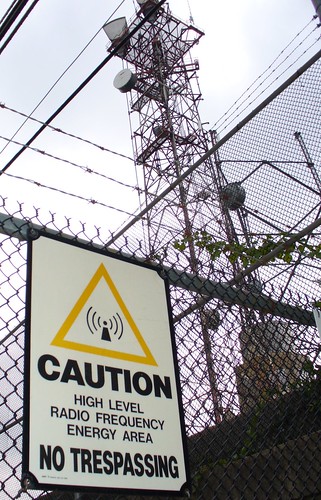
Radio tower photo by Bill Adler